
Differences in the construction of lead and lead-free x-ray aprons – What influences the choice?
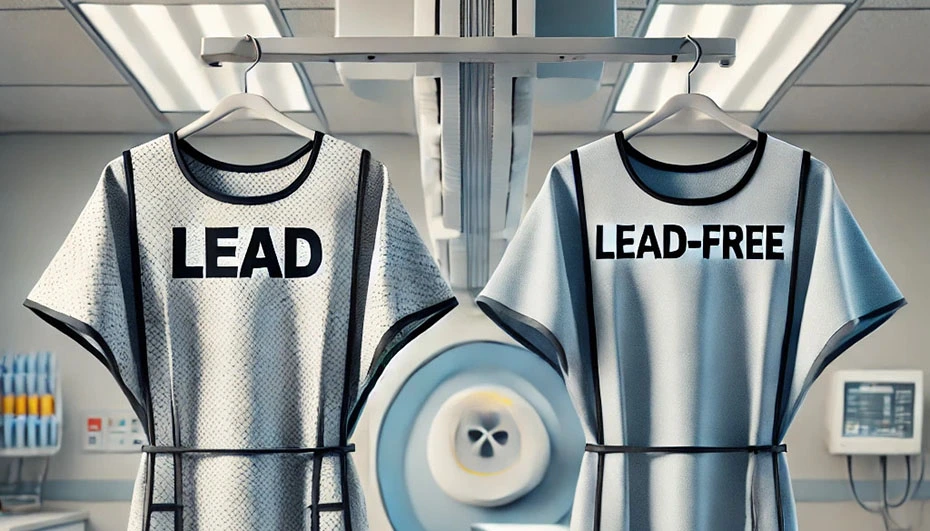
When working with X-ray radiation, there is no room for compromise when it comes to safety. Personal protection must be effective, but also adapted to working conditions and the user’s capabilities. Among the most important elements of protective clothing are X-ray aprons, whose primary function is to absorb harmful ionizing radiation.
There are two main structural types of aprons on the market: lead and lead-free. Both protect against radiation but differ in construction, physical properties, wearing comfort, and environmental impact. In this article, we compare them from a practical perspective to help make an informed choice.
Lead x-ray apron – A classic radiological protection
Physical properties and role in apron construction
Lead has been the primary protective material used in X-ray clothing for decades. Its exceptionally high density makes it effective at blocking X-ray radiation. In apron construction, lead is used in the form of a flexible compound, laminated with an outer layer—typically nylon or vinyl. Lead aprons are available in various protective equivalents, such as 0.25 mm, 0.35 mm, or 0.50 mm Pb.
Although they provide high protection, they are relatively heavy—especially noticeable during prolonged use. Weight is most commonly cited as a drawback of traditional lead aprons, particularly by physicians performing long procedures. In many cases, however, their effectiveness compensates for the inconvenience.
Advantages of lead aprons
- High protection effectiveness at high radiation voltages
- Long-lasting durability and resistance to wear
- Stability and proven technology
Where are they most useful?
Lead X-ray aprons are commonly used in conventional radiology, vascular surgery, and anywhere maximum protection from high radiation exposure is required. Lead models available in the Coradika offering are widely appreciated by professionals who value reliable solutions and product durability.
Next-generation alternative – Lead-free x-ray aprons
Modern materials and their effectiveness
Lead-free X-ray aprons respond to the growing demand for lighter and more environmentally friendly protective measures. Their construction incorporates blends containing metals such as bismuth, antimony, or tungsten. While their density is lower than that of lead, the layered structure ensures a comparable level of protection.
Typical components of lead-free aprons
- Bismuth – effective, non-toxic, often used in pediatrics
- Antimony – flexible and lightweight, provides solid protection in blends
- Tungsten – very dense, allows for thinner layers with high efficiency
Application and wearing comfort
Lead-free aprons are especially recommended for individuals who wear protective clothing most of the day—such as X-ray technicians or fluoroscopy operators. The lower weight significantly relieves the spine, reducing the risk of strain injuries. They are also popular among women and individuals with smaller body frames.
Coradika offers lead-free aprons made from certified, high-performance materials that combine protection with ergonomic design.
Protection effectiveness comparison
Lead equivalence vs. actual protection
Both lead and lead-free aprons are available in the same protection classes—for example, 0.35 mm Pb. This equivalence means that a lead-free apron offers a level of protection comparable to a 0.35 mm layer of pure lead. In practice, the user is protected to the same degree, regardless of the material used.
However, protection effectiveness may vary depending on the X-ray tube voltage. Studies show that lead-free aprons perform better within the radiation range up to around 90 kV, while classic lead models may more effectively attenuate deeper radiation at higher voltages.
Impact of construction on side protection and mobility
Lead-free materials are more flexible, allowing the apron to better conform to the body. This translates to increased protection in critical areas such as the hips or underarms. Additionally, the apron fits the silhouette better, does not protrude, and avoids gaps through which scattered radiation might penetrate.
Impact of material on weight and ergonomics
One of the main arguments for choosing a lead-free apron is its weight. Compared to its lead counterpart, it can be up to 30–40% lighter. For the user, this means significantly reduced strain on muscles and joints, leading to less fatigue at the end of the workday.
Benefits of lower apron weight
- Greater comfort during prolonged wear
- Reduced risk of back and shoulder pain
- Improved mobility and freedom of movement
In mobile work—such as bedside imaging or in veterinary clinics—a lead-free apron makes it easier to move and handle equipment. Most modern models in Coradika’s personal protection range also include ergonomic fastenings, waist adjustments, and reinforced shoulder sections to help distribute weight more evenly.
Durability and maintenance of x-ray protective aprons
Lead aprons are more resistant to creases and deformation, but their rigidity can make them more prone to cracking during intensive use. In contrast, the flexible structure of lead-free aprons makes them less vulnerable to permanent mechanical damage—especially when properly maintained and stored on hangers.
Environmental aspect and disposal
Ecology is playing an increasingly important role in the selection of personal protective equipment. Despite its excellent protective properties, lead is toxic. The disposal process of a damaged lead apron requires specialized procedures and involves additional costs. Improper disposal can result in environmental contamination.
Thanks to non-toxic materials, lead-free aprons are easier to recycle and pose no threat to the environment. For many facilities focused on sustainable development and environmental certifications, this is a decisive factor when making a purchase.
What to choose? Summary of differences and practical conclusions
The choice between a lead and lead-free apron depends on the user’s individual needs. If maximum protection at high voltages and stationary work are essential, a classic lead apron will be a good choice. However, if comfort, mobility, and ergonomics are the priority, it’s worth considering a lead-free apron.
Both types are available in the Personal Protective Equipment section of Coradika, which offers verified, certified products tailored to various specialties. It’s worth consulting with a supplier to choose an apron suited not only to the work performed but also to individual physical preferences.


